

Jiangsu Tent Environmental Technology Co., Ltd. : Your Professional Standard AHU Manufacturer!
TENT Central Air Conditioning was founded in 2007 with a registered capital of 100 million yuan. Headquartered in Shanghai, it has over 30 sales and after-sales service centers in East China, Central China, North China, South China, Southwest, and Northwest China. It is a HVAC equipment integrator and system energy-saving solution provider that integrates research and development, manufacturing, sales, and service. We have two manufacturing bases in Jiangsu and Hebei, covering a total area of 50000 square meters. Our sales and installation service network is spread throughout the country.
Complete Qualifications
Our company has passed Quality Management System Certification, Environmental Management System Certification, Occupational Health and Safety Management System Certification, Intellectual Property Management System Certification, Enterprise Credit Rating Certificate, High tech Enterprise Certificate, CRAA Product Certification, and China Energy Conservation Product Certification. Additionally ,our rooftop air conditioner has obtained many industry-leading technology certifications, such as first-class energy efficiency certification, CRAA certification, energy saving certification, CCC certification and so on.
Strong Production Capability
Our company is located in Nantong city, Jiangsu province, which is engaged in the research, production and sales of fresh air conditioner, rooftop air conditioner, floor standing air conditioner, air-cooled modular chillers, purification air conditioners and so on. Tent possesses two production bases in Nantong Jiangsu and Hengshui Hebei, with total 80,000 square meters production area.
Rich Products
Our products cover rooftop air conditioning series, commercial fresh air conditioning series, central air conditioning host series, commercial/industrial air conditioning series, central air conditioning terminal series, planting air conditioning series, which can be used in medical, educational, residential, commercial, chemical, planting, industrial, aerospace and other systems.
Production Equipment
Our factory is equipped with advanced machines to meet production needs, including: 1 set of fully automatic uncoiling and leveling machine, 2 sets of 3kW laser cutting machines, 7 sets of bending machines, 2 sets of high-precision turret punching machines, 3 sets of closed high-speed punching machines, 2 sets of long U-shaped pipe bending machines, 2 sets of non shrinkage expansion pipe machines, 10 sets of final assembly production lines, and 2 sets of foam workshops.

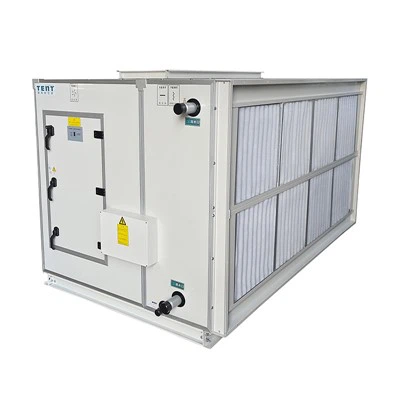
What is Standard AHU?
An air handling unit (AHU) , sometimes called an air handler, is a piece of equipment that is used to condition and circulate air as a component of a heating, ventilating and air conditioning system. This handler is usually a large metal box that contains a blower, heating and cooling elements, filter chambers, sound attenuators and dampers. The air handler connects to ductwork that in turn, distributes the conditioned (and heated or cooled) air throughout the building before returning it to the AHU.
Benefits of Standard AHU


Improved Indoor Air Quality
AHUs enhance indoor air quality by effectively filtering dust, allergens, and pollutants from incoming air, creating a healthier, more comfortable environment. Choosing a reputable AHU manufacturer ensures high-quality filtration systems that capture pollutants effectively.
Energy Efficiency
AHUs are essential for energy-efficient buildings. A reputable AHU manufacturer designs units with advanced features like variable speed drives (VSDs) and energy recovery systems. VSDs adjust the fan speed to reduce energy wastage, while energy recovery systems reuse heat or coolness from outgoing air, minimizing additional heating or cooling needs.
Customization and Flexibility
A reliable AHU manufacturer understands the unique requirements of each building and offers customized solutions. They tailor the AHU design, dimensions, and features to integrate seamlessly into the building’s infrastructure, optimizing airflow and conditioning. Through collaboration, you can work with a manufacturer to get specialized solutions that satisfy your unique building needs.
Enhanced Performance and Reliability
High-quality AHUs from reputable manufacturers deliver consistent, reliable performance, undergo rigorous testing, and meet industry standards for durability. By investing in AHUs from a reliable manufacturer, you gain confidence in their performance, efficiency, and longevity. A reputable AHU manufacturer also provides comprehensive after-sales support, including installation assistance, maintenance services, and genuine replacement parts, minimizing downtime and ensuring smooth operation.
Temperature Control
By incorporating heating and cooling elements, AHUs help maintain optimal temperature levels within a building. This ensures that occupants can work, study, or engage in activities comfortably regardless of external weather conditions.
Humidity Regulation
Maintaining appropriate humidity levels is vital for occupant comfort and overall well-being. AHUs equipped with humidifiers and dehumidifiers help control humidity, preventing issues such as dry skin, respiratory irritation, and mold growth. By ensuring a balanced moisture level, AHUs contribute to a healthier indoor environment.

An Air Handling Unit (AHU) is a crucial component in Heating, Ventilating, and Air Conditioning (HVAC) systems, responsible for circulating and regulating air as part of the building’s heating, cooling, and ventilation systems. These units come in various configurations, each designed to meet specific requirements regarding space, air quality, and efficiency.
Horizontal Type Air Handling Unit
These AHUs are designed for installation in ceilings, crawl spaces, or attics, where space constriction does not allow for larger units. Horizontal AHUs are particularly useful in residential or light commercial settings. Their layout facilitates easy maintenance and typically operates at lower noise levels, making them suitable for environments where noise could be a concern.
Vertical Type Air Handling Unit
Vertical AHUs are designed to stand upright, making them ideal for installations with limited horizontal space. They are often found in mechanical rooms or basements and can serve multiple floors simultaneously. Vertical units efficiently distribute air vertically and are remarkably space-saving compared to horizontal models.
Air Intake and Filtration
The AHU draws in outside air through the air intake section. The air first passes through filters, which trap particles such as dust, pollen, and allergens. This filtration process helps improve indoor air quality by removing contaminants.
Conditioning the Air
After filtration, the air moves to the heating or cooling elements, depending on the desired temperature. Heating coils or cooling coils adjust the air temperature accordingly. The HVAC system provides the necessary energy source for heating or cooling.
Humidity Control
If the air needs humidification or dehumidification, the AHU employs humidifiers or dehumidifiers to adjust the humidity levels. Humidifiers add moisture when the air is too dry, while dehumidifiers remove moisture when the air is too humid.
Air Circulation and Distribution
Once the air is conditioned and the humidity levels are controlled, the fans within the AHU circulate the air. The fans create a continuous flow, pushing the conditioned air through the ductwork and vents to reach different areas of the building. This ensures that every space receives the conditioned air, providing a comfortable and consistent environment throughout the building.

Applications of Standard AHU
Commercial Buildings
AHUs are commonly used in office buildings, retail stores, hotels, and restaurants to provide conditioned air for occupants’ comfort and well-being. They are also integral to maintaining indoor air quality in healthcare facilities, schools, and public buildings.
Industrial Facilities
In industrial settings such as manufacturing plants, warehouses, and cleanrooms, AHUs play a critical role in controlling humidity, temperature, and airborne contaminants to ensure product quality, process efficiency, and worker safety.
Data Centers
Data centers rely on precision air conditioning systems with AHUs to maintain optimal temperature and humidity levels for the reliable operation of sensitive electronic equipment. AHUs with redundant components and advanced filtration are essential for preventing downtime and equipment failures.
Residential HVAC Systems
In residential buildings, AHUs are part of central HVAC systems that provide heating, cooling, and ventilation to individual dwelling units. These units enhance indoor air quality, energy efficiency, and occupant comfort in homes and apartments.
Components of Standard AHU
Fans
Fans are responsible for moving air through the AHU and into the building’s ductwork. They come in various configurations, including centrifugal fans and axial fans, and can be equipped with variable speed drives (VSDs) for energy efficiency and airflow control.
Filters
Air filters remove dust, pollen, allergens, and other particulate matter from the incoming air, improving indoor air quality and protecting downstream components from contamination. Filters are classified based on their efficiency rating, ranging from basic panel filters to high-efficiency particulate air (HEPA) filters.
Heating and Cooling Coils
Heating and cooling coils, also known as coils or heat exchangers, regulate the temperature of the air passing through the AHU. Heating coils use hot water or steam, while cooling coils use chilled water or refrigerants to heat or cool the air, respectively.
Humidifiers and Dehumidifiers
Humidifiers add moisture to the air to prevent dryness, while dehumidifiers remove excess moisture to maintain optimal humidity levels. These components are essential for comfort control and preventing issues such as mold growth and condensation.
Dampers
Dampers are adjustable valves or louvers located within the AHU’s ductwork, regulating the flow of air to different zones or spaces. They can be manually operated or motorized and are used for temperature zoning and energy conservation.
Factors to Consider When Choosing Standard AHU
Choosing the Right Air Handling Unit (AHU) for your building is pivotal, impacting indoor air quality, energy efficiency, and comfort. AHUs are integral HVAC components, conditioning and distributing air. For an informed decision, consider these factors tailored to your building’s needs, including the option to buy air handling systems.
Building Type and Size
The type and size of your building are fundamental determinants when choosing an AHU. Commercial buildings, industrial facilities, hospitals, and residential structures have varying HVAC requirements. Large buildings might require multiple AHUs to efficiently cater to different zones or floors. Assess your building’s purpose and size to establish the foundation for your AHU selection.
Climate and Environmental Conditions
Local climate significantly influences AHU selection. Regions with extreme temperatures, high humidity, or frequent fluctuations may necessitate specialized AHUs with features like heat recovery or humidity control. A thorough understanding of local environmental conditions is vital for selecting an AHU that can effectively address climate-related challenges.
Indoor Air Quality (IAQ) Requirements
IAQ is paramount for occupant health and comfort. Consider the IAQ standards or regulations applicable to your building type and location. AHUs with advanced filtration systems, precise temperature and humidity control, and air exchange capabilities are essential for maintaining high IAQ standards.
Energy Efficiency
In today’s ecologically concerned world, energy efficiency is a key factor. Seek AHUs designed with energy-saving features such as variable speed drives (VSDs) for fans, heat recovery systems, and energy-efficient motors. Energy-efficient AHUs not only reduce operational costs but also contribute to sustainability goals.
Maintenance and Accessibility
Ensure that the selected AHU is easily accessible for maintenance and repairs. Rooftop units, for example, are placed on building rooftops to save indoor space but must be accessible for servicing. Consider AHUs that provide easy access to filters, coils, and other components, reducing downtime during maintenance.
Flexibility and Scalability
Buildings may evolve, with changing space requirements and HVAC needs. Opt for AHUs that offer flexibility and scalability, allowing for modifications or expansions as needed. Modular AHUs, in particular, can be customized and adapted to changing building configurations.
Budget Considerations
Your budget is a significant factor in AHU selection. Balancing AHU performance with cost is crucial. Assess the initial purchase price and long-term operational and maintenance expenses for an informed decision.
Noise Levels
AHUs can generate noise during operation, which can be disruptive to occupants. Consider the acceptable noise levels for your building and select AHUs with noise-reduction features such as insulated panels, vibration isolators, and Acoustical treatments.
Control Systems
AHUs with advanced control systems provide precise control over temperature, humidity, and airflow. Integrated control systems can also offer remote monitoring and management, allowing for real-time adjustments and proactive maintenance.
Compliance with Regulations
Ensure that the selected AHU complies with local and national regulations, including energy efficiency standards and IAQ requirements. AHUs that meet or exceed these standards are more likely to provide optimal performance and long-term reliability.
Frequently Asked Questions
We're well-known as one of the leading standard ahu manufacturers and suppliers in China. Be free to wholesale customized standard ahu from our factory. Contact us for more cheap products.
temperature control for vineyards, cooling and heating for blackberry production, temperature control for peach orchards